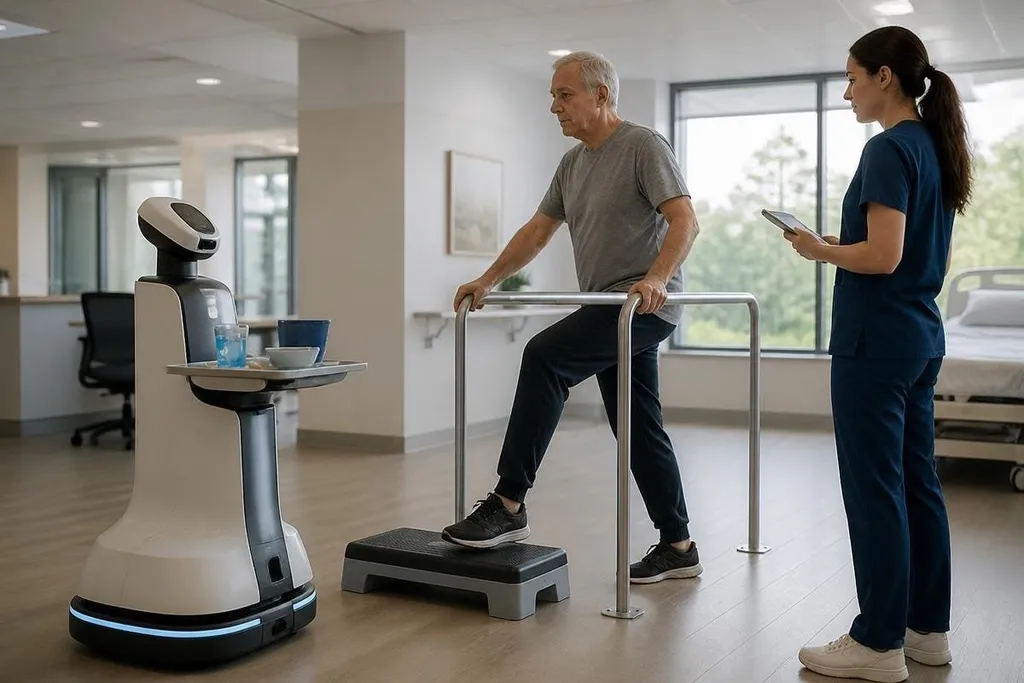
A healthcare robot may move a tray, guide a patient through exercises, or hold a surgical tool. AI changes the software behind those tasks by helping the robot read its surroundings, choose an action, and adjust when conditions change.
The hard part is proof. A staged demo still needs safe behavior, clear records, and human control in a hospital.
- AI can help robots read cameras, force sensors, and room maps.
- Human approval remains necessary for tasks that can affect patient safety.
- The open question is how well these systems work outside controlled trials.
Where AI fits in the robot
Working around patients requires more than motors and arms. The robot must tell a person from a bed rail, spot an object on a tray, and understand where its own joints are. Computer vision, a form of software that reads images, can help with the first part.
Machine learning can also sort sensor data into useful signals. A force sensor may show that the robot has touched a person, a door, or a metal frame. The software then has to choose a safe response, such as slowing the arm or stopping it.
That response depends on the task. A hospital delivery robot can use cameras and maps to move through corridors. A rehabilitation robot needs to react to a patient’s movement. A surgical system faces a smaller work area, tighter limits, and a higher need for direct human control.
What changes for hospital work
AI may reduce the number of fixed steps a robot needs before it can act. A delivery robot that only follows marked routes needs a prepared building. One that can read a map and adjust to a blocked corridor may handle more day-to-day changes.
The same idea applies to patient support. Software can compare a patient’s current movement with a planned exercise and tell the robot when the pace or force needs to change. That does not make the robot a clinician. It gives the clinician another way to set limits and review progress.
For a hospital manager, the useful question is not whether a robot uses AI. It is which decision the software makes, what data it reads, and what happens when the data is wrong.
The hospital examples that follow need more than a claim about AI. Reporting at Robot24 can tie each claim to the machine and task behind it, giving the next section a concrete starting point when software makes a bad call.
The safety gap
AI systems can make mistakes when a room, patient, or task differs from the data used to train them. A camera may lose sight of a hand under a blanket. A map may miss a temporary cart. A movement model may read pain or weakness as a normal change in motion.
A safe design needs a clear fallback. The robot should stop at a defined limit, alert a person, and record what it sensed before the stop. Staff also need a physical emergency stop and a way to take control without waiting for the software.
Privacy adds another limit. Cameras, movement records, and patient data need strict access rules. A hospital should ask where the data is stored, who can view it, how long it stays there, and whether the robot can work with less data.
AI may make a robot more flexible, but flexibility makes testing harder. A fixed routine can be checked step by step. A system that changes its action needs tests across rooms, lighting, patient movement, and staff behavior.
A buying checklist
Before a hospital pilot, ask for answers to these points:
- Name the task: What will the robot do, and what will remain under staff control?
- Set the limits: Which speed, force, distance, and payload limits can staff change?
- Check the fallback: What does the robot do after a lost camera view, blocked route, or bad sensor reading?
- Review the record: Can staff see the input, action, stop, and person who took control?
- Protect patient data: Where does the data go, and can the system run with less collection?
- Define success: Which measured result ends the pilot, such as fewer transport trips or more completed therapy sessions?
The last point keeps the purchase tied to hospital work. A robot may move well and still fail to reduce staff load, improve therapy practice, or fit the ward’s rules.
AI will matter most when it changes a measured task without hiding the decision behind software. For healthcare robots, the next useful proof is not a smoother demo. It is a record showing safe work across a real ward, with a person able to stop the robot at any moment.